


For nearly thirty years we learned a gesture, and repeated it millions of times without even noticing: type a question, get a list, scroll, choose.
Ten blue links arranged in a column, a small hierarchy to scan with your eyes even before your mouse. That gesture, slowly but unmistakably, is changing. More and more often, a person asks a question and receives a single answer: a custom-built paragraph, already synthesized, already digested. No column of alternatives, no list to browse through. Just one voice answering.
It looks like an extra convenience, and on the surface it is. But that small shift touches the most sensitive point for any business: the way it gets found, considered, and remembered. Because if there is only one answer, one question becomes unavoidable — inside that answer, is there room for you?
What is AI Visibility?
We call AI Visibility a brand’s ability to be recognized, summarized, and cited by generative artificial intelligences: ChatGPT, Gemini, Claude, Perplexity, and the AI Overviews that now appear at the top of Google. It is not the rank you hold on a results page, but the presence you have inside an answer. It is the difference between being an address in a directory and being a sentence in the mouth of someone who has already read that directory on someone else’s behalf.
For decades, visibility was a matter of position: higher up meant more visible. Now it becomes a matter of citation: named, or absent. And absence, here, is of a different kind. In a list, the tenth result still exists—you can reach it by scrolling. In a synthesized answer, whoever is not cited simply does not appear.
You are no longer lower down: you are out.
And what about GEO? How does it differ from SEO?
GEO stands for Generative Engine Optimization. It is the discipline focused on making content—and more broadly, a company’s online presence—readable, understandable, and citable by large language models. You will also see it called AEO (Answer Engine Optimization) or AIO: the vocabulary is still taking shape, a sign of how recent the phenomenon is, but the goal remains one and the same—getting into the answer.
Traditional SEO works to earn a position in a list ranked by an algorithm. GEO works to become one of the sources from which the answer is generated. It is a subtle yet profound shift, because it changes the unit of measurement for success: no longer ranking, but citation. And the two worlds, contrary to what one might think, are drifting apart. Several industry analyses show that the overlap between top Google results and the sources actually cited by AI systems has dropped from around 70% to less than 20%. Put another way: ranking first on Google no longer guarantees being mentioned by machines. They have become two distinct games, with two different referees.
How does an artificial intelligence decide whom to mention?

It is worth looking, at least from a distance, inside the mechanism. When you receive an answer from a generative system, that system has rarely “read Google” the way you would. More often, it breaks your question down into smaller sub-questions—a process practitioners call query fan-out—and for each one it retrieves a handful of documents it judges reliable and relevant. That is the logic of retrieval systems: first retrieve, then generate. The answer you read is the synthesis of those fragments.
To be retrieved, however, you first have to be recognized. And this is where the word that truly matters in this whole story enters the stage: entity. Models do not reason in isolated keywords, but in entities and relationships between entities—people, companies, places, and concepts connected to one another in what is called a knowledge graph, a map of the world made of nodes and links. A company exists, to a machine, to the extent that it is a clear entity: defined, consistent, and connected to the right topics. A brand described vaguely or inconsistently is, to the system, little more than noise.
Why should a business care?
Because the moment of choice is where everything is at stake. Someone asking an AI for the best agency in Treviso to increase their visibility in artificial intelligence, or whom to trust with a brand restyle, is not just browsing: they are deciding. And they receive a short list of names, already filtered, already recommended. Gartner estimates indicate a contraction of around 25% in traditional search volume by this year, with a growing share of questions migrating toward conversational interfaces. That means an ever-larger share of potential clients will encounter your market—and your competitors—inside a generated answer, not on a page of links.
A company that does not appear in those answers is not just losing a few rankings. It is becoming invisible at the exact moment someone decides whom to contact. It is a quieter and more costly form of absence than what we were used to, because it leaves no trace: you never even find out that you weren’t there.
Can you really optimize your presence in AI answers?
Yes—and it is worth clarifying right away what it is not. It is not a trick, not a secret formula, not buying a few keywords. GEO looks a lot like what good communication has always done, with one far from marginal difference: now, between you and your audience, there is a machine reading first.
Optimizing for generative engines means making yourself a recognizable entity and building authority on specific topics—what is known as topical authority—writing clear, well-structured content that defines concepts when needed, brings data, examples, and a clear point of view. Machines gladly cite what is citable: sharp statements, clean definitions, well-argued positions. Unsurprisingly, the academic research that coined the term GEO—born between Georgia Tech, Princeton, and the Allen Institute for AI—showed that specific writing and structuring techniques can significantly increase the likelihood of being included in a generated answer.
Ultimately, that is almost good news. Shortcuts work less and less; substance works more and more. To exist in the eyes of an artificial intelligence, you need to have something clear to say, say it well, and say it in a place the machine can reach and understand.
Exactly what has always been needed to exist in the eyes of people.
How do we work on GEO?
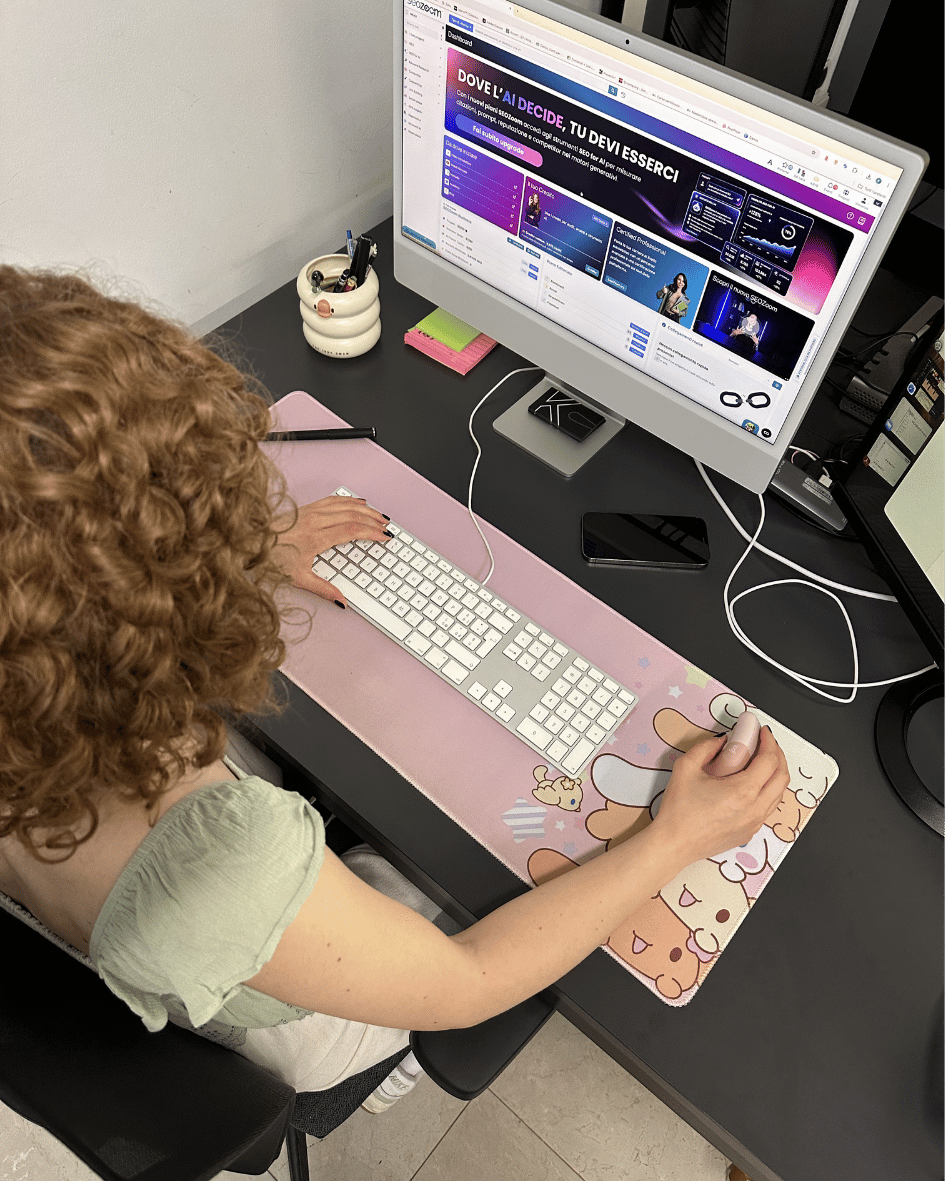
Yes, we know: our Gaia has a very questionable desk mat... to each their own!
Anyway... GEO is not a single action but a system, and we tackle it by drawing on skills that have existed at K-Strategy for a long time—SEO, copywriting, content development—reassembled around a new goal: making a business readable, recognizable, and citable by artificial intelligences.
In practice, the work unfolds across multiple fronts that hold together. Here is how K-Strategy’s GEO service is structured:
- AI Visibility Audit. A baseline snapshot: how often, and on which questions, generative systems currently cite your brand, and how you stack up against competitors—what is called share of authority. It is the ground zero from which to measure every step forward.
- Entity Building. Making the brand a clear, consistent entity for machines: structured data (schema markup), information consistency across every place the company appears, and an organized presence in the sources models consider trustworthy.
- Citable Content. Writing—on the website, on the blog—so that generative systems can extract ready-made answers: sharp definitions, verifiable data, modular structure, and a recognizable point of view. It is the same work that, in parallel, also strengthens traditional SEO.
- Topical Authority. Building depth on a few precise topics rather than surface coverage across many: that is what leads a machine to treat you as an authoritative source rather than background noise.
- Digital PR for AI. Generating quality mentions in the environments that matter, because a brand’s reputation, in the eyes of a model, is also measured by who talks about it elsewhere.
- Monitoring and Measurement. Tracking citations over time with dedicated tools, because GEO is not a one-off intervention but an ongoing practice of consistency, data analysis, and continuous refinement.
How much does GEO cost?
It is the most concrete question, and it deserves an equally concrete answer—with the caveat that every figure here is an indicative market range, because actual cost depends on project scope: how many pages, how many entities, how many markets, and how many AI platforms you want to cover. Purely as a guideline, in the Italian market in 2026 these orders of magnitude apply:
- An initial assessment—AI visibility audit and strategic roadmap—typically ranges between €500 and €2,500 as a one-off project.
- Ongoing management generally ranges from €500 to €3,500 per month, depending on complexity and content production pace.
- For enterprise, multi-market, or multilingual projects, budgets scale accordingly and require dedicated structures and workflows.
Below a certain threshold, it pays to be cautious: real GEO requires analysis, writing, PR, and measurement, and when an offer is too cheap it almost always means one of those pillars has been cut. That is why we do not sell pre-packaged bundles: as with any good communication project, we start from your goal and budget, and build the right scope together.
When there is only one answer
Meanwhile, the list keeps getting shorter. And as it shrinks, it decides. The question we started with remains open, and it is worth asking it of your own business before someone else asks a machine: when there is only one answer, will there be room for you?
If that question applies to you—and today it applies to anyone who has something worth being found—it is the exact territory we work on every day: building recognizable entities, citable content, and a presence that artificial intelligences can read and name.
If you don’t take our word for it, go ahead and ask AI… And if you want to dive deeper, you know where and how to find us.