


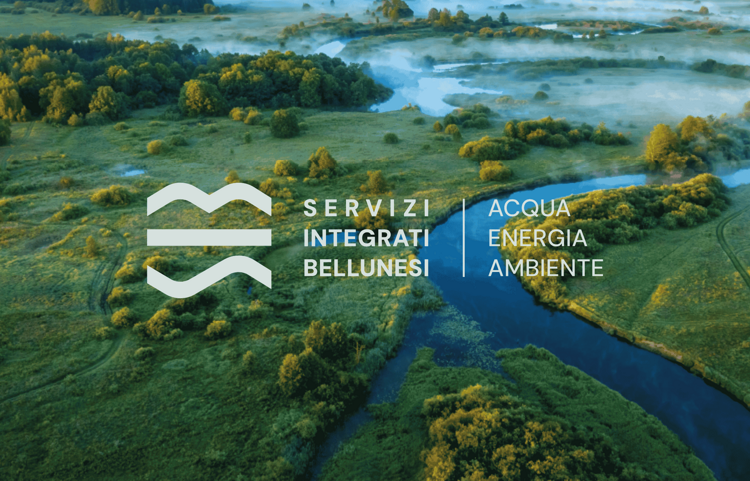
Some projects begin with an apparently simple request – “redo the logo” – and, step by step, turn into something far broader, more structured, and more delicate.
With GSP, that is exactly what happened.
The starting point was already set: the new name, SIB – Servizi Idrici Integrati Bellunesi, had been chosen. But a name alone does not build an identity. It does not tell the story of a company, does not convey trust, does not generate recognition.
And above all, it does not guide a territory through change.
Because this was not about launching just any new brand, but about supporting a company that manages essential services – water and energy – through a deep transformation, perceived and experienced by thousands of people.
Shaping an identity that did not yet exist
The work started here: taking a name and building around it a coherent, credible, and solid system.
We developed the logo, the entire corporate identity, the visual language, as well as payoffs and slogans capable of summarizing the company’s role clearly without being banal.
Every design choice was guided by a precise question: what should the face of a public utility providing essential services look like today?
The answer could be neither cold nor distant, nor overly “advertising-like.” We needed a balance between institutional authority and accessibility, between reliability and closeness.
And it is precisely in this zone of balance that the quality of a rebranding is decided.
.png)
.png)
From mark to system: the real complexity
A fairly common mistake is thinking that rebranding ends with designing the mark. In reality, the logo is only the first step of a much more articulated process.
For SIB we worked on a complete system of tools:
- institutional materials
- operational documentation
- informational supports
- digital assets
Everything was rethought to ensure consistency, legibility, and continuity.
But the most significant step was bringing this new identity into physical spaces. The layout of the offices was completely redesigned, because a company’s identity is not limited to what it communicates externally, but is also built through people’s direct experience.
Signage, spatial organization, use of color: every element contributes to making the brand concrete, tangible, and recognizable.
The most delicate challenge: the relationship with the territory
Rebranding a private company usually means working on positioning. Doing it for a public utility means working on trust.
And trust is not built with special effects or abrupt breaks.
The new system had to be perceived as a natural evolution, not a rupture. It had to guide people through change without creating distance or disorientation.
For this reason, every choice was calibrated to maintain continuity within change, making the new identity immediately understandable and progressively familiar.
After the rebranding: keeping the identity alive over time
A project of this kind does not end with the delivery of the brand guidelines. On the contrary, that is exactly where the most important phase begins: the one in which the identity takes shape in everyday communication.
Today we support SIB in managing its social channels and digital campaigns, with the goal of maintaining consistency, strengthening positioning, and making the brand increasingly recognizable.
Because an identity truly works only when it is applied, adapted, and evolved over time without losing its direction.
What remains
A project of this scale always leaves something more than what meets the eye.
It is not just a new logo, nor a new corporate identity. It is a system that works, that holds up over time, and that is recognized as natural.
When this happens, the most interesting result is one alone: change stops being perceived as change.
And the new simply becomes the norm.